

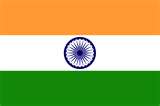
Officially India is the Republic of India
India is the seventh-largest country by geographical area, the second-most populous country with 1.18 billion people, and the most populous democracy in the world. India is bounded by the Indian Ocean on the south, the Arabian Sea on the west, and the Bay of Bengal on the east; and is bordered by Pakistan, China, Nepal, Bhutan, Bangladesh and Burma. India has a coastline of 7,517 kilometers (4,700 mi).
Home to the Indus Valley Civilization and a region of historic trade routes and vast empires, the Indian subcontinent was identified with its commercial and cultural wealth for much of its long history. Four major religions, Hinduism, Buddhism, Jainism and Sikhism originated here, while Zoroastrianism, Judaism, Christianity and Islam arrived in the first millennium CE and shaped the region's diverse culture.
From the 16th century, European Portugal, the Netherlands, France, and Great Britain established trading posts and later took advantage of internal conflicts to establish colonies in the country. By 1856, most of India was under the control of the British East India Company. A year later, a nationwide insurrection of rebelling military units and kingdoms, known as India's First War of Independence or the Sepoy Mutiny, seriously challenged the Company's control but eventually failed. As a result of the instability, India was brought under the direct rule of the British Crown. In the 20th century, a nationwide struggle for independence was launched by the Indian National Congress and other political organizations. Indian leader Mahatma Gandhi led millions of people in several national campaigns of non-violent civil disobedience.
On 15 August 1947, India gained independence from British rule, but at the same time the Muslim-majority areas were partitioned to form a separate state of Pakistan. On 26 January 1950, India became a republic and a new constitution came into effect.
India is a federal constitutional republic consisting of 28 states and seven union territories with a parliamentary system of democracy. The Indian economy is the world's eleventh largest economy by nominal GDP and the fourth largest by purchasing power parity. Economic reforms since 1991 have transformed India into one of the fastest growing economies in the world; however, it still suffers from poverty, illiteracy, corruption, disease, and malnutrition. In 1974, India conducted an underground nuclear test and five more tests in 1998, making India a nuclear state. India has the third-largest standing army in the world. India is considered to be a potential superpower, having a rapidly growing economy and growing political clout. A pluralistic, multilingual and multiethnic society, India is also home to a diversity of wildlife in a variety of protected habitats.