


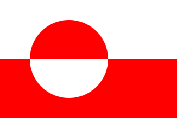

Greenland is an autonomous country within the Danish Realm, located between the Arctic and Atlantic Oceans, east of the Canadian Arctic Archipelago. Though physiographically a part of the continent of North America, Greenland has been politically and culturally associated with Europe (colonial powers Norway and Denmark and nearby Iceland.) Three-quarters of Greenland is covered by the only permanent ice sheet outside of Antarctica. With a population of about 56,480 in 2013, it is the least densely populated country in the world.
Greenland has been inhabited off and on for at least the last 4,500 years by Arctic peoples who migrated from Canada. Norsemen settled the uninhabited southern part of Greenland beginning in the 10th century, and Inuit peoples arrived in the 13th century. The Norse colonies disappeared in the late 15th century. In 1499, the Portuguese briefly explored and claimed the island, naming it Terra do Lavrador. In the early 18th century, Scandinavia and Greenland came back into contact, and Denmark-Norway affirmed sovereignty over the island.
Denmark–Norway claimed Greenland for centuries. Greenland was settled by Norwegians, who had previously settled Iceland, to escape persecution from the King of Norway and his central government. It was from Greenland and Iceland that Norwegians set sail to discover America for Europeans almost 500 years before Columbus. The Kingdom of Norway was extensive and a military power until the mid-14th century. However the Black Death hit Norway with a larger death toll than Denmark it forced Norway to accept a union in which the central government, university and fundamental institutions were located in Copenhagen. The two kingdoms' resources were directed at creating Copenhagen, resulting in Norway becoming the weaker part and losing sovereignty over Greenland in 1814 in the dissolution of the union. Greenland thus became a Danish colony in 1814, and a part of the Danish Realm in 1953 under the Constitution of Denmark.