


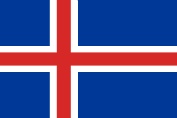

The Republic of Iceland, is a Nordic island country between the North Atlantic and the Arctic Ocean. Iceland is closer to continental Europe than to mainland North America; thus, the island is generally included in Europe for historical, political, cultural, and practical reasons. With a population of 329,100 and an area of 140,000 square miles it is the most sparsely populated country in Europe. The capital and largest city is Reykjavík. Reykjavík and the surrounding areas are home to over two-thirds of the population. Iceland is volcanically and geologically active. The interior consists of a plateau characterized by sand and lava fields, mountains and glaciers with many glacial rivers that flow to the sea through the lowlands. Iceland is warmed by the Gulf Stream. Despite its high latitude just outside the Arctic Circle, Iceland has a temperate climate. Its high latitude and marine influence still keeps summers chilly, with most of the archipelago having a tundra climate.
It is generally accepted that the settlement of Iceland began in the year 874 when the Norwegian chieftain Ingólfr Arnarson became the first permanent settler on the island at present day Reykjavík. The Icelandic Commonwealth lasted until the 13th century, when internal struggles and civil strife led to the signing of the Old Covenant in 1262, which ended the Commonwealth and brought Iceland under the Norwegian crown. From 1262 to 1814, Iceland was ruled by Norway and afterwards by Denmark. Until the 20th century, the country relied largely on fishing and agriculture. Iceland became independent in 1918 and a republic in 1944. Industrialization of the fisheries and Marshall Plan aid following World War II brought prosperity and Iceland became one of the wealthiest and most developed nations in the world. In 1994, it became a part of the European Economic Area, which supported diversification into economic and financial services.