



Tibet
Tibet is the traditional homeland of the Tibetan people as well as other ethnic groups including the Monpa, Tamang, Qiang, Sherpa, and Lhoba peoples. It is now inhabited by considerable numbers of Han Chinese from mainland China. As a region, Tibet is the highest elevation on Earth, with an average elevation of 5,000 m (16,000 ft). The highest elevation in Tibet is Mount Everest, Earth's highest mountain, rising 8,848 m (29,029 ft) above sea level.
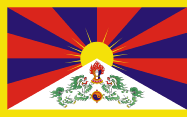
I have included the Tibetan flag at the top of this page. You will not see this flag anywhere in Tibet. You only see the Chinese flag. The Tibetan flag, also known as the "snow lion flag" was the flag of independent Tibet from 1916 to 1951. It was adopted by the 13th Dalai Lama in 1916. It has been banned by the PRC since 1959. However, it is used by the Tibetan Government in Exile, in Dharamshala, India.
The Tibetan Empire emerged in the 7th century, with the rule of Songtsen Gampo (604–650 CE), who united parts of the Yarlung River Valley and founded the Tibetan Empire. The current borders of Tibet were generally established in the 18th century.
Following the Xinhai Revolution against the Qing dynasty in 1912, the new Republic of China apologized for the actions of the Qing Dynasty and offered to restore the Dalai Lama's title. The Dalai Lama refused any Chinese title and declared himself ruler of an independent Tibet. For the next 36 years, the 13th Dalai Lama and the regents who succeeded him governed Tibet. In 1914 the Tibetan government signed the Simla Accord with Britain, ceding the South Tibet region to British India. The Chinese government denounced the agreement as illegal.
When, between 1930s and 1940s, the regents displayed negligence in national affairs, the Kuomintang Government of the Republic of China took advantage to expand its reach into the territory. The region maintained its autonomy until 1951 following the Battle of Chamdo,
The Battle of Chamdo [October 6 thru October 19, 1950] was a military campaign by the People's Republic of China (PRC) to take the Chamdo Region from a de facto independent Tibetan state after months of failed negotiations on the status of Tibet. The campaign was not to invade Tibet but to capture the Lhasa army occupying Chamdo, demoralize the Lhasa government, to exert pressure to get Tibetan representatives to agree to negotiations in Beijing and to sign terms recognizing China's sovereignty over Tibet. However, the campaign resulted in the capture of Chamdo and negotiations between the PRC and Tibetan representatives that resulted in the annexation of Tibet by the People's Republic of China.
Today, China governs western and central Tibet as the Tibet Autonomous Region. Before the Tiananmen Square protests of 1989, monks in the Drepung and Sera monasteries started protesting for independence. The government halted reforms and started an anti-separatist campaign. Human rights organizations have been critical of the Beijing and Lhasa governments' approach to human rights in the region when cracking down on separatist activities that occurred around monasteries and cities, most recently in the 2008 Tibetan unrest. Tensions are high regarding Tibet's political status with dissident groups active in exile. Tibetan activists in Tibet have reportedly been arrested and tortured.
About Tibet 1